


What is Buyback Yield?
Buyback Yield is a financial metric used to measure the effectiveness of a company’s share repurchase program in returning value to its shareholders. It is a component of the broader concept of Shareholder Yield, which includes dividends, buybacks, and debt reduction.
When a company repurchases its shares, it reduces the number of outstanding shares in the market, thereby increasing the value of the remaining shares. This benefits shareholders by increasing their stake in the company without the need to purchase additional shares. Buyback Yield focuses solely on the buyback component, offering a clear view of how much a company is returning to shareholders through stock repurchases.
How to Calculate Buyback Yield?
The formula to calculate Buyback Yield is simple:

Buyback Yield = Share Repurchases / Market Capitalization
In this formula,
- Share Repurchases refers to the total value of shares a company has repurchased during a given period.
- Market Capitalization is the total market value of a company’s outstanding shares (calculated by multiplying the stock price by the number of outstanding shares).
This formula provides the percentage of the company’s market capitalization that is being used to buy back shares.
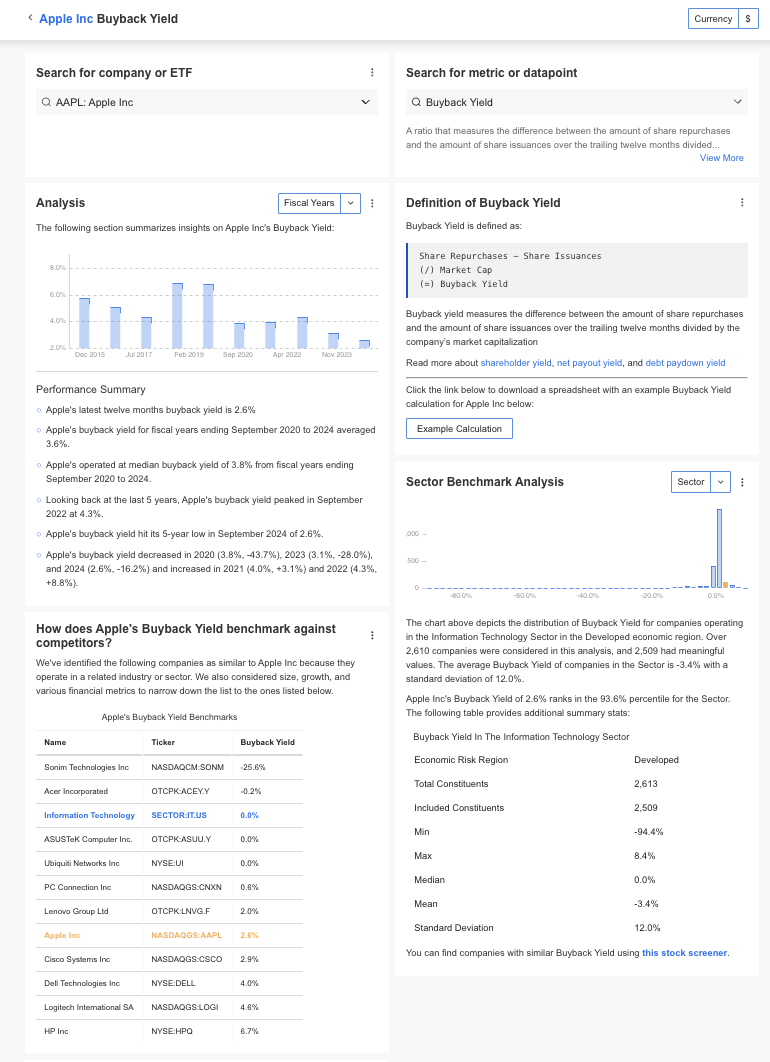
Example Calculation of Buyback Yield
Let’s assume that a company has the following financial data:
- Share Repurchases: $200 million
- Market Capitalization: $10 billion
Using the formula:
Buyback Yield = Share Repurchases / Market Capitalization
Buyback Yield = 200,000,000 / 10,000,000,000 = 0.02 or 2%
In this case, the company’s Buyback Yield is 2%, meaning that the company is repurchasing 2% of its total market value in shares, effectively increasing the value for existing shareholders.
Why is Buyback Yield Important?
Buyback Yield is an essential metric for investors to evaluate how companies are returning capital to their shareholders. Unlike dividends, which provide regular cash payments, share buybacks directly reduce the number of outstanding shares, thus increasing the value of each remaining share.
The importance of Buyback Yield lies in its ability to reflect a company’s strategic financial decisions, such as the allocation of excess cash, the perceived value of the company’s shares, and its confidence in long-term growth.
Here are some reasons why Buyback Yield is essential:
Signal of Confidence
A high Buyback Yield can signal that a company’s management believes its shares are undervalued and is confident in its future performance. This can attract investors looking for companies with growth potential.
Buybacks reduce the number of shares outstanding, which can increase Earnings Per Share (EPS). This can make a company appear more profitable, often boosting stock prices in the short term.
Capital Allocation Effectiveness
Buyback Yield helps investors evaluate how well a company is using its capital. Companies that generate significant cash flow but have limited growth opportunities may choose to repurchase shares as a way to return capital to shareholders.
Support for Stock Price
During market downturns, companies may use buybacks to support or increase their stock price by reducing supply. This can help stabilize the stock and potentially prevent it from falling further.
Flexibility Compared to Dividends
Unlike dividends, which represent a fixed payment, share buybacks are more flexible. Companies can adjust the size of buybacks based on current financial conditions, making them a more adaptable option for returning capital to shareholders.
How to Interpret Buyback Yield?
Investors often use Buyback Yield to gauge whether a company is undervalued or whether it is allocating resources effectively to maximize shareholder returns. A consistent or increasing Buyback Yield can signal that the company believes its stock is undervalued and is making effective use of its capital, while a decrease or lack of buybacks could suggest a lack of confidence or a strategic shift in priorities.
Here are a few key points to consider when interpreting Buyback Yield:
High Buyback Yield
A high Buyback Yield typically signals that a company is aggressively repurchasing shares. This can be positive if it suggests that the company’s shares are undervalued, but it could also indicate that the company lacks profitable growth opportunities and is relying on buybacks to enhance shareholder value.
Low or Negative Buyback Yield
A low or negative Buyback Yield indicates that the company is not engaged in significant share repurchases. This could suggest that the company is focusing on other priorities, such as reinvesting profits into the business or reducing debt.
Buyback Yield vs. Dividend Yield
Comparing Buyback Yield with Dividend Yield can provide insights into how a company is returning capital to shareholders. A higher Buyback Yield than Dividend Yield suggests the company may prefer buybacks over dividends, while an equal balance might indicate a more traditional capital allocation strategy.
Consistency Over Time
The consistency of Buyback Yield over time is also crucial. A company that maintains a steady or increasing Buyback Yield may demonstrate a consistent commitment to returning value to shareholders, whereas fluctuations could signal uncertainty or changing priorities.
What is a Good Buyback Yield?
A good Buyback Yield depends on the context of the company’s financial position, industry, and overall market conditions. Here are some general guidelines:
- Low Buyback Yield (Below 1%): A low Buyback Yield could suggest that the company is not focusing on share repurchases, possibly because it prefers to invest in growth opportunities, reduce debt, or maintain liquidity for other purposes.
- Buyback Yield Between 2-4%: A Buyback Yield in this range is often considered healthy, indicating that a company is actively repurchasing shares and returning capital to shareholders. It suggests the company believes its shares are undervalued or has excess cash.
- High Buyback Yield (Above 5%): While a high Buyback Yield can be a positive signal, it may also raise concerns about the company’s lack of growth prospects or reliance on buybacks to maintain stock price levels. Investors should carefully assess the reasons behind such a high yield.
- Industry-Specific Benchmarks: Some sectors, such as technology, may naturally have higher Buyback Yields due to their cash-rich balance sheets, while others, like utilities, may have lower Buyback Yields due to the capital-intensive nature of their operations.
What are the Limitations of Buyback Yield?
While Buyback Yield is a useful metric for assessing how much capital a company is returning to shareholders through share repurchases, it has several limitations that investors should be aware of. These limitations can impact the accuracy of the metric and its interpretation, particularly when used in isolation.
Does Not Reflect Company Growth
Buyback Yield focuses solely on repurchases and ignores the broader picture of a company’s growth potential. A company may buy back shares, but if it isn’t growing or investing in innovation, the buybacks might not add long-term value.
Short-Term Focus
Buybacks can temporarily boost earnings per share (EPS) and stock prices, but this does not necessarily indicate sustainable growth. Investors should be cautious of companies using buybacks to mask poor operational performance.
Debt-Funded Buybacks
Companies sometimes take on additional debt to fund buybacks, which can increase financial risk. If a company is using borrowed money for share repurchases, this could negatively impact long-term financial stability and should be considered when evaluating the Buyback Yield.
Market Timing Risks
The timing of buybacks is crucial. If a company repurchases shares when its stock is overpriced, it could be wasting capital that could have been better utilized elsewhere. Conversely, buying back shares when the stock is undervalued can be an effective use of capital.
Buyback Yield only measures the impact of share repurchases and does not take into account other forms of shareholder value, such as dividends or debt reduction. A comprehensive analysis of shareholder returns requires considering all components, not just buybacks.
How to Find Buyback Yield?
InvestingPro offers detailed insights into companies’ Buyback Yield including sector benchmarks and competitor analysis.
InvestingPro+: Access Buyback Yield Data Instantly
Unlock Premium Data With InvestingPro 📈💸
Gain instant access to Buyback Yield data within the InvestingPro platform
🛠 Access to 1200+ additional fundamental metrics
🔍 Competitor comparison tools
📊 Evaluate stocks with 14+ proven financial models
Buyback Yield FAQ
What does Buyback Yield measure?
Buyback Yield measures the percentage of a company’s market capitalization that is being used for stock buybacks. It highlights the company’s commitment to returning value to shareholders through share repurchases.
How do Buybacks affect stock prices?
Buybacks can lead to an increase in stock price by reducing the number of shares outstanding, thus making the remaining shares more valuable. This can be a sign of confidence from the company in its own future prospects.
How does Buyback Yield differ from Dividend Yield?
Buyback Yield reflects share repurchases, while Dividend Yield measures the cash dividends paid to shareholders. Both are methods of returning value, but buybacks impact the share count, while dividends provide regular cash payouts to investors.
Can Buyback Yield be used alone to assess a company’s performance?
No, Buyback Yield should not be used in isolation. It is important to consider it alongside other metrics such as earnings growth, dividend yield, debt levels, and overall capital allocation strategy to get a complete picture of a company’s financial health.
Does Buyback Yield always indicate strong company performance?
Not necessarily. While buybacks can be a sign of confidence, they can also be used by companies to mask underlying financial challenges or a lack of profitable growth opportunities. It is important to analyze the company’s overall strategy and financial position.


 App Store
 Google Play