


What Is Days Payable Outstanding (DPO)?
Days Payable Outstanding (DPO) is a financial metric used to gauge how long a company takes to pay its invoices to suppliers and creditors. It represents the average number of days a company holds onto its cash after receiving goods or services before settling its outstanding accounts. DPO is a key component in managing cash flow, as companies can use this metric to improve cash management, boost working capital, and optimize financial flexibility.
How to Calculate Days Payable Outstanding (DPO)?
The formula to calculate Days Payable Outstanding is as follows:

DPO = (Accounts Payable / Cost of Goods Sold (COGS)) × Number of Days
In this formula,
- Accounts Payable (AP) represents the total amount a company owes to its suppliers at a specific time.
- Cost of Goods Sold (COGS) is the direct costs attributable to the production of goods sold or services provided by the company.
- Number of Days typically is 365 days for an annual calculation.

Example Calculation of Days Payable Outstanding
Let’s calculate the Days Payable Outstanding (DPO) for a Company ABC, a mid-sized manufacturing firm. Mentioned below are the company’s relevant financial information:
- Accounts Payable at Year-End 2022: $620,000
- Accounts Payable at Year-End 2023: $680,000
- Cost of Goods Sold (COGS) for 2023: $4,500,000
- Time Period: 365 days (annual calculation)
Step 1: Calculate the Average Accounts Payable
To get a consistent measure over the period, we’ll use the average of the beginning and ending accounts payable balances for 2023:
Average Accounts Payable = (Accounts Payable at 2022 Year End + Accounts Payable at 2023 Year End) / 2
(620,000 + 680,000) / 2 = 650,000
Step 2: Apply the DPO Formula
With the average accounts payable calculated, we can now determine the DPO for Company ABC:
DPO = (650,000 / 4,500,000) × 365
DPO = 0.1444 × 365 = 52.7 days
This result indicates that Company ABC takes approximately 52.7 days, on average, to pay its suppliers in 2023.
Why is Days Payable Outstanding Important?
DPO is an essential tool for financial planning and analysis. It helps businesses understand and control the timing of cash outflows, allowing them to make the best use of available capital. A well-managed DPO can enable a business to:
Increase Cash Flow: By maximizing the time before payments are due, companies can retain cash for longer, providing flexibility to cover other expenses or invest in growth.
Strengthen Supplier Relationships: While delaying payments may benefit cash flow, it’s important for companies to balance DPO with the need to maintain good terms with suppliers.
Optimize Working Capital: Efficiently managing DPO helps a business maximize its working capital, allowing it to operate smoothly and manage unexpected expenses or investment opportunities.
Industry Comparisons: DPO is particularly useful when comparing companies within the same industry. Some industries, such as manufacturing, may have longer payment terms due to the nature of the supply chain, while service-based industries might have shorter payment cycles. Understanding the industry average DPO allows businesses to evaluate their performance relative to peers.
How to Interpret DPO?
Generally, a high DPO indicates that a company holds onto its cash for an extended period, which may allow it to reinvest funds or cover short-term expenses. Conversely, a low DPO suggests that a company pays its bills more quickly, which might reflect a strong relationship with suppliers but could also limit the firm’s liquidity.
Understanding DPO’s implications is critical, as it varies by industry and operational strategy:
High DPO: Companies with a high DPO, often exceeding industry norms, hold onto their cash for longer, which can improve short-term liquidity. However, this can strain supplier relationships if the payment delay affects the suppliers’ cash flow. In some cases, a high DPO may also suggest that a company is financially struggling, leading it to delay payments.
Low DPO: Firms with a low DPO may pay suppliers more quickly, which can indicate strong relationships and possibly qualify for early payment discounts. However, this practice might restrict cash flow, leaving the company with less liquidity to address sudden financial needs or investment opportunities.
Factors Affecting DPO
Several elements can influence a company’s DPO, including:
Industry Standards: Industries with extended supply chains, like manufacturing, often have higher DPOs, while retail or service-based businesses may operate with lower DPOs.
Supplier Payment Terms: Negotiated payment terms, such as net-30 or net-60 days, directly impact DPO.
Company’s Financial Health: Companies with stable cash flows may opt for shorter DPOs to build stronger supplier relationships, while those needing to conserve cash may extend their DPO.
Business Strategy: Firms prioritizing liquidity often extend DPO, while those focused on supplier loyalty may shorten payment times.
How Can Businesses Optimize DPO?
Managing DPO effectively requires balancing cash flow needs with supplier relationship management. Here are strategies businesses can consider to optimize DPO:
- Negotiate Favorable Payment Terms: Working closely with suppliers to secure extended payment terms can lengthen DPO without damaging relationships.
- Implement Efficient Payment Processing Systems: Automated payment systems reduce processing time and ensure timely payments, helping companies avoid late fees and maintain control over cash outflows.
- Take Advantage of Early Payment Discounts: In cases where cash flow is strong, taking advantage of early payment discounts can reduce expenses and strengthen supplier partnerships.
- Balance DPO with Cash Flow Needs: Regularly reviewing DPO in the context of cash flow and working capital needs helps ensure that the strategy supports overall financial health.
By strategically managing Days Payable Outstanding, companies can gain flexibility and improve cash flow, which is vital for both short-term operational needs and long-term growth. A balanced approach to DPO, factoring in industry standards and supplier relationships, ensures a company can effectively leverage this metric to enhance its financial health and operational efficiency.
Limitations of DPO
While DPO is a useful metric, it has limitations. One of the key drawbacks is that it does not provide insight into the broader picture of a company’s financial health.
For example, DPO does not account for the timing of cash inflows, such as customer payments, which can significantly affect liquidity. Additionally, DPO does not consider other critical factors like the quality of supplier relationships or the company’s overall creditworthiness.
How to Find Days Payable Outstanding
InvestingPro offers detailed insights into companies’ DPO including sector benchmarks and competitor analysis.
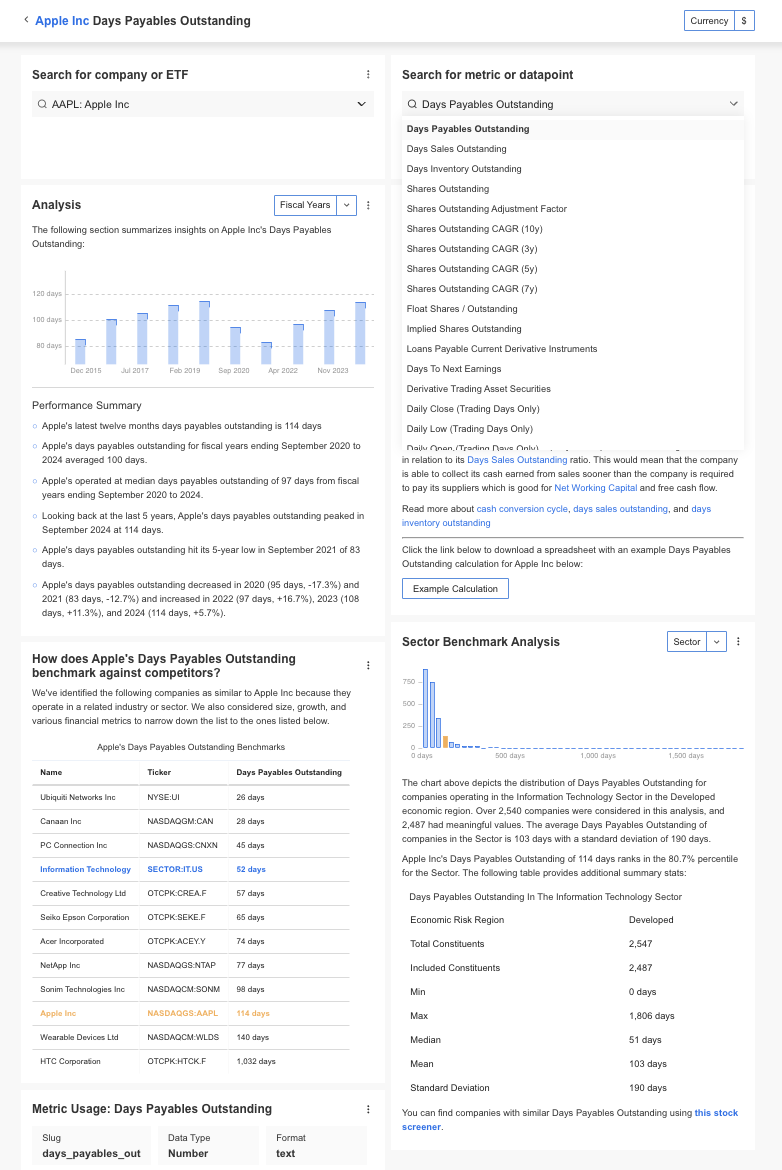
InvestingPro: Access Days Payable Outstanding Data Instantly
Unlock Premium Data With InvestingPro 📈💸
Gain instant access to DPO data within the InvestingPro platform
🛠 Access to 1200+ additional fundamental metrics
🔍 Competitor comparison tools
📊 Evaluate stocks with 14+ proven financial models
Days Payable Outstanding (DPO) FAQs
Why is DPO a critical metric for cash flow management?
DPO helps businesses determine how long they can retain cash before paying suppliers, aiding in cash flow management. A high DPO can improve liquidity, while a low DPO may build supplier goodwill.
What is considered a “good” DPO?
A good DPO depends on industry norms, company goals, and financial health. Generally, firms should aim for a DPO that aligns with industry standards while supporting cash flow objectives.
How does DPO differ from Days Sales Outstanding (DSO)?
DPO measures how long a company takes to pay suppliers, while Days Sales Outstanding (DSO) indicates how long it takes to collect payment from customers. Together, they offer insights into a company’s cash conversion cycle.
Can a high DPO harm a company?
Yes, excessively delaying payments can strain supplier relationships and, in some cases, harm the company’s reputation. It’s essential to balance DPO with the need for strong supplier partnerships.
Is it better to have a high or low DPO?
The ideal DPO depends on the company’s goals. A higher DPO can help with liquidity but may impact supplier relationships, while a lower DPO can build goodwill but may strain cash flow.
How does DPO impact the Cash Conversion Cycle (CCC)?
DPO is one component of the Cash Conversion Cycle (CCC). A higher DPO can reduce CCC, indicating improved liquidity by slowing cash outflows.


 App Store
 Google Play